
Air conditioner or portable AC?
Published
This article comes from a somewhat biased source, since we sell and install fixed air conditioners. Let's still look at it critically.
Summer heat gets a lot of people looking for an effective cooling solution. The two most popular options are fixed air conditioners and portable AC units. Which one fits your needs better? In this article we weigh the pros and cons of both, so you can make a better decision.
Choosing between a fixed air conditioner and a portable AC comes down to your needs, the space, and your budget.
Fixed air conditioners are more energy efficient, using up to half as much electricity for the same cooling output, and their indoor units can be up to three times quieter than portable AC units. On top of that, a fixed unit's piping is more discreet, making it a more attractive, permanent solution, especially for larger spaces where its stronger airflow really pays off.
A portable AC unit, on the other hand, can cost less than a third of a fixed unit's purchase price and offers flexibility, since you can move it from room to room as needed. That makes it a practical choice for cooling a single room or a small space. While a portable unit is noisier and less energy efficient, it can be a perfectly adequate, cost-effective solution for temporary or small-scale use.
Performance: Is the cooling capacity enough for your needs?
Do you need to cool your whole home, or just certain rooms? If it's the latter, a portable AC unit might be enough. Our rule of thumb is that if the space you're cooling is under 25 m², a fixed air conditioner can be a bit of overkill.
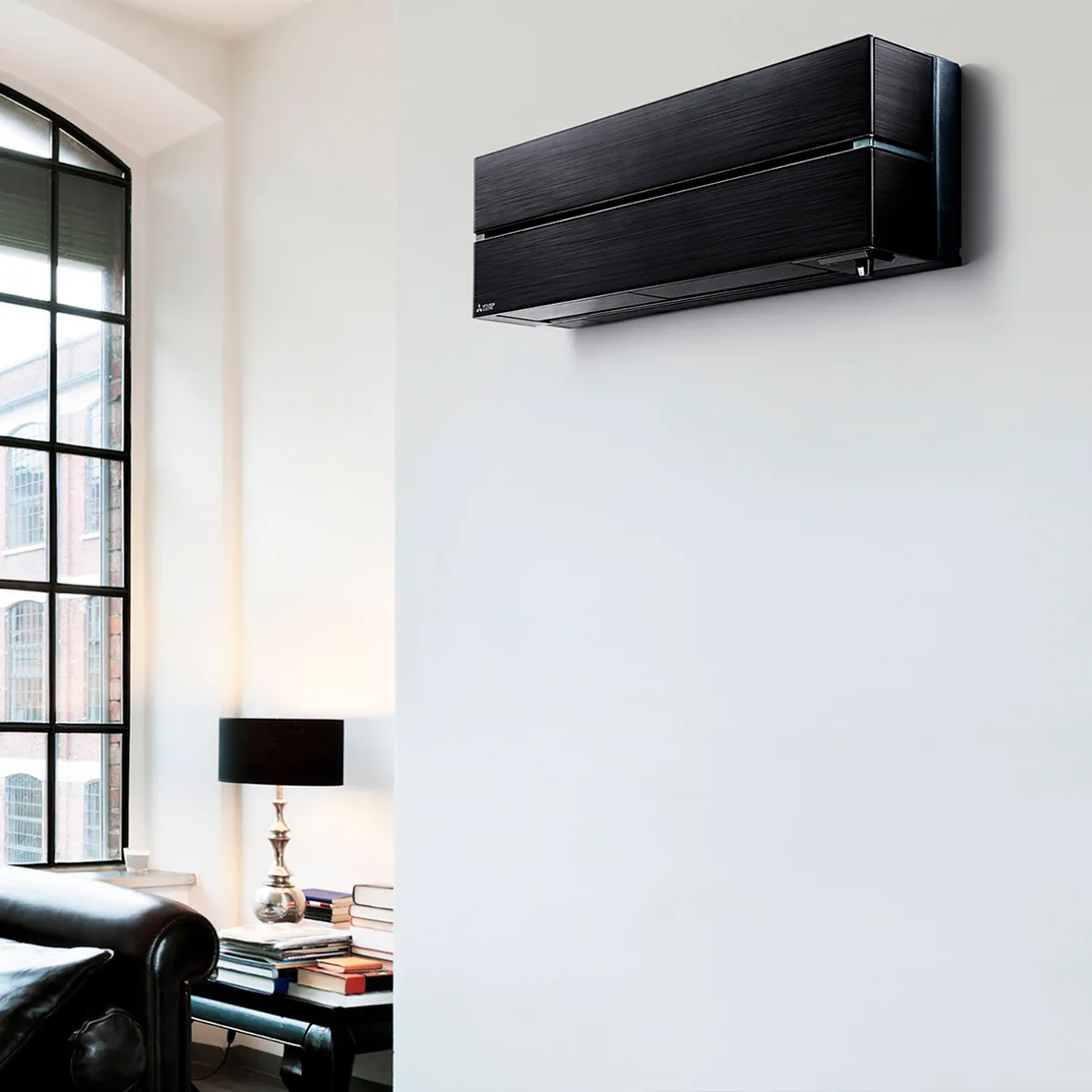
A fixed air conditioner is usually mounted high on a wall, which allows for efficient air circulation and cooling of larger spaces. It can make an entire home feel cool within a few hours.
A portable AC unit, meanwhile, cools the immediate area around it and suits smaller rooms better. Its performance can be limited by the exhaust hose it needs to vent outside, which can let heat back into the room, affecting the unit's efficiency.
Quietness: Will the noise bother you?
How important is quiet operation for your use case? If noise doesn't bother you, a portable AC unit can work just fine.
A fixed air conditioner's compressor sits outdoors, so its indoor unit runs almost silently. That makes it an excellent choice for bedrooms and other spaces where quiet matters.
A portable AC unit can be noisier, since its compressor sits inside the unit itself. Modern portable units are considerably quieter than older models, though, and can be tolerable in, say, a home office or for temporary use.
Convenience: A fixed solution, or flexible portability?
Do you want a permanent solution, or do you need the flexibility a portable unit offers?
A fixed air conditioner is a permanent installation, which makes it a hassle-free, long-term solution. Once it's in place, it's easy to use, with nothing to move or set up again. On top of that, the moisture that collects in the indoor unit, the condensate, drains outside on its own through a hose.
A portable AC unit does offer flexibility, though. You can move it from room to room as needed, which can be a real advantage if you need cooling in different places at different times. The downside is having to set up the exhaust hose every time and empty the condensate tank.
Price: Is the investment worth it?
Do you have the budget for a long-term solution, or do you need a cheaper option for short-term use?
Finland's hot season is shorter than in many other warm countries. Even so, the average number of hot days in Finland has been steadily rising. The decade average has grown from 29 hot days in the 1960s to 45 hot days in the 2020s.
A fixed air conditioner is often a significant investment that requires professional installation. Over the long run, though, it can be a cost-effective solution, since it typically uses less energy than a portable unit. On top of that, being a permanent part of the home, it can add to the property's value.
A portable AC unit is considerably cheaper up front, but running it can end up costing more due to lower efficiency and higher electricity use. It also likely won't last as long as a fixed air conditioner.
Looks: Blend in, or stand out?
Do you value a permanent, unobtrusive solution, or does appearance matter less for temporary use?
There are real differences in appearance between a fixed air conditioner and a portable AC unit that can affect your purchase decision.
A fixed air conditioner's indoor unit takes up very little space, since it's mounted high on the wall, out of the way of your living space. Its outdoor unit is considerably larger (typically around 80 cm wide and 30 cm deep), but since it's placed on a balcony or another outdoor spot, it doesn't get in the way indoors. The indoor and outdoor units are connected by wall-mounted piping, covered by a plastic trunking channel.
Portable AC units, on the other hand, are larger and more noticeable, since they sit on the floor and take up more room space. A portable unit needs an exhaust hose connected to a window or vent, which can make it feel more like a temporary fix. Aesthetically these units don't always blend into a modern interior, though the market also has sleeker, more compact models.
Comparing the technical specs of example units
| Model | Cooling capacity | SEER rating | Annual energy use | Sound pressure level | Price | Lifespan |
|---|---|---|---|---|---|---|
| Toshiba Seiya+ 10 air conditioner | 2.5 kW | 7.0 (A++) | 125 kWh | Indoor unit 20–41 dB, outdoor unit 43–48 dB | €1,820 installed | ~15 years |
| Electrolux Comfort 600 portable AC | 2.6 kW | 3.6 (A++) | 256 kWh | 64 dB | €597 | ~10 years |
Notes on the comparison
The Toshiba Seiya+ is considerably more energy efficient thanks to its higher SEER rating (7.0 vs. 3.6), which means lower energy use over the long run.
Sound pressure levels are significantly lower on the Toshiba Seiya+, for both the indoor and outdoor units, making it the quieter option.
The Electrolux Comfort 600 portable AC is the considerably cheaper option.